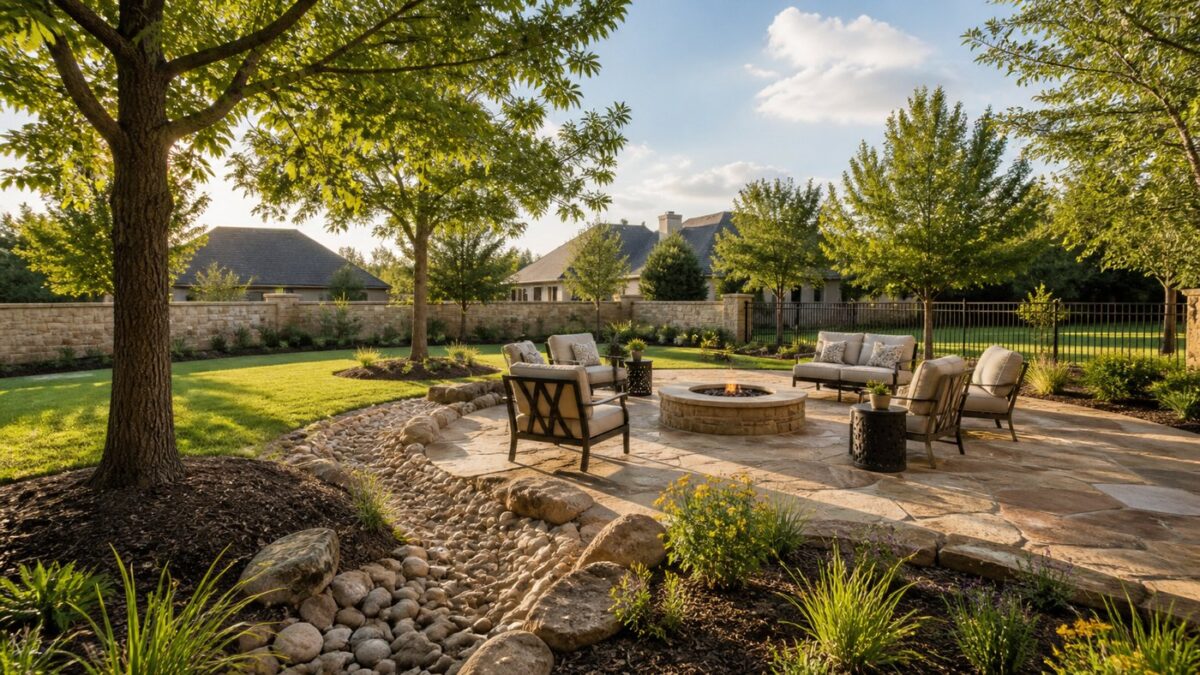
Summary: How should homeowners approach Flower Mound patio shade tree planning in Flower Mound with mature-size and hardscape-conflict prevention?
The useful first step in Flower Mound patio shade tree planning is to define the decision before anyone treats the work as routine. In Flower Mound and the wider North Texas setting, a good plan starts with what can be observed on the property: why choosing a shade tree near a patio is being considered, what sits nearby, what outcome matters, and which questions need current confirmation. This answer-first approach is intentionally practical. It does not turn a web page into a permit ruling, a diagnosis, an engineering opinion, or a promise about results.
Begin by recording the patio’s intended use: morning coffee, afternoon shade, dining, circulation, or a play area. Then add the tree’s mature canopy, branch habit, litter pattern, root-zone needs, and maintenance expectations. That small amount of preparation makes a site conversation more efficient and helps separate a visible condition from an assumption about its cause. For related context, see the JChavez Flower Mound home page and Flower Mound patio and shade-tree planning resource.
What should a Flower Mound patio shade tree planning review in Flower Mound include before work is scoped?
A useful review makes the site legible. Walk the area from more than one angle, take a wide photo and a close photo, and note boundaries, slopes, gates, roofs, paving, landscape beds, visible lines, irrigation components, and places people commonly use. The goal is not to decide every technical question from the sidewalk. It is to create a clear record of what is present and what should be discussed in person.
The record should also capture where runoff, irrigation, downspouts, retaining features, and paving edges meet the landscape. Flower Mound yards can combine mature landscaping with compact access, changing grades, and several improvement projects over time. A decision that seems isolated can affect the next project. For example, Flower Mound patio and shade-tree planning resource can help frame a nearby concern, while Flower Mound patio and shade-tree planning resource provides another internal reference.
| Observation | Why it matters | Useful next question |
|---|---|---|
| Location and access | Shapes practical scope and protection needs | What route and work area are realistic? |
| Nearby structures or landscape | Identifies targets and coordination points | What needs to remain protected or accessible? |
| Water and soil clues | May affect timing and follow-up questions | Where does water move after rain or irrigation? |
| Visible utilities or lines | Calls for caution and confirmation | Who should verify the applicable utility information? |
How do Flower Mound patio shade tree planning decisions in North Texas change with site conditions and timing?
North Texas weather can make timing feel urgent, especially after wind, hail, or intense rain. Urgency should not erase observation. If there is an immediate danger, keep people away from the area and avoid improvised work near overhead conductors, unstable material, or damaged structures. When the condition is not immediate, document it and use the record to compare options. The National Weather Service and Ready.gov offer useful severe-weather preparation context through Texas A&M AgriLife Extension and USDA NRCS Web Soil Survey.
Local conditions also shape the questions worth asking. whether parcel-scale soil information and actual site observations point to a different design conversation. Rather than assuming that every lot behaves the same way, use broad references as context and observe the actual property. ISA mature tree care can help a homeowner understand a topic, but it does not replace a site-specific assessment.
Practical before-work checklist
- Photograph the area from wide, medium, and close views.
- Mark gates, parking, lines, irrigation, and sensitive surfaces on a simple sketch.
- Write down the outcome you want and the outcome you want to avoid.
- Separate confirmed facts from questions that need current verification.
- Plan for cleanup, material handling, and access after the work area is cleared.
Which Flower Mound patio shade tree planning warning signs in Flower Mound deserve documentation instead of assumptions?
Warning signs are observations, not verdicts. Changes in alignment, cracking, wet areas, dead branches, disturbed soil, surface movement, or repeated drainage patterns can all be worth recording. Take photos with a consistent viewpoint, include a familiar object for scale when safe, and note when the condition appeared. This creates a timeline that is more useful than a single memory after a storm or a busy season.
Avoid ‘fixing’ the evidence before it is understood. Cutting roots, opening a drainage path, removing material, or making large pruning cuts can alter the site and complicate later decisions. Where digging is part of the contemplated work, EPA WaterSense landscaping tips is an appropriate resource to consult. For another locally relevant discussion, read Flower Mound patio and shade-tree planning resource.
What is a sensible Flower Mound patio shade tree planning process for Flower Mound homeowners and property managers?
- Define the objective. State what prompted the project and what a satisfactory result would look like.
- Document conditions. Collect photos, basic dimensions, access notes, and recent weather or maintenance context.
- Verify current constraints. Use the relevant Town, utility, or project resource for questions that cannot be answered by a generic article.
- Review the site. Discuss the observations, scope choices, sequencing, and protection needs in person.
- Coordinate follow-up. Confirm cleanup, monitoring, and adjacent work so the area is not left as an afterthought.
This process is deliberately adaptable. It supports a small residential project, a shared fence line, or a property manager coordinating several areas. It also prevents overconfidence: a clean checklist is not a substitute for current municipal information, utility coordination, or specialized evaluation when the facts call for one. The Town’s current information is available through EPA WaterSense landscaping tips.
How can a Flower Mound Flower Mound patio shade tree planning comparison keep scope, access, and cleanup clear?
When comparing approaches, ask each party to describe the same work area and desired outcome. A meaningful comparison distinguishes observation, included work, exclusions, access assumptions, material handling, and what happens if a site condition changes. It is better to ask for clarity than to assume that a familiar phrase covers every step.
| Planning item | Write it down as | Why it improves clarity |
|---|---|---|
| Work objective | Specific condition and desired result | Keeps options comparable |
| Access | Gate, route, parking, and obstacles | Reduces surprises on arrival |
| Protection | Surfaces, plants, structures, or features to discuss | Focuses the site conversation |
| Cleanup | Material, chips, soil, and final appearance | Clarifies the handoff |
For projects that overlap other landscape work, sequencing is often the differentiator. Flower Mound patio and shade-tree planning resource and Flower Mound patio and shade-tree planning resource can help a reader list the coordination points before requesting a conversation.
How can Flower Mound homeowners document Flower Mound patio shade tree planning choices for a careful next-step conversation?
A short project record is one of the most useful tools a homeowner can bring to a conversation about Flower Mound patio shade tree planning. Start with the date, a plain-language description of the concern, and photos taken from the same safe locations. Add a simple drawing that labels the house, fence, patio, driveway, drainage direction, gates, trees, wall faces, or other features that matter. If a condition followed a storm, irrigation change, construction activity, or prior maintenance, write that down without concluding that it caused the condition. The distinction matters: a timeline helps people investigate; an assumption can send a project in the wrong direction.
Then turn the record into questions. Ask what is known, what needs to be verified, what access assumptions are being made, and what work might affect the next phase. Include the patio’s intended use: morning coffee, afternoon shade, dining, circulation, or a play area and where runoff, irrigation, downspouts, retaining features, and paving edges meet the landscape. Ask how debris, soil, chips, materials, or runoff will be handled, and how the finished area will connect to adjacent features. This helps a homeowner compare explanations of scope rather than compare vague labels. It also gives property managers a reusable format for communicating with residents, neighbors, or maintenance teams without overstating what has been found.
Project-note data card
- Condition: What can be seen, where it appears, and when it was first noticed.
- Context: Recent weather, watering, traffic, construction, or maintenance worth mentioning.
- Constraints: Gates, slope, lines, structures, shared boundaries, and areas people use.
- Questions: Current-rule, utility, drainage, tree-care, or sequence questions that require confirmation.
- Desired handoff: Cleanup expectation, follow-up observation, and any adjacent project to coordinate.
This documentation does not replace professional judgment. It makes that judgment easier to apply to the right facts. It is especially valuable when choosing a shade tree near a patio intersects with more than one service or when the site has changed over time. Retain the original photos, note the date of any work, and revisit the same views after weather events. A clear record can reveal whether a visible issue is stable, changing, or simply being viewed differently from day to day.
What infographic concept explains Flower Mound patio shade tree planning in Flower Mound with a clear decision path?
Infographic concept: ‘Observe → Verify → Coordinate → Act → Monitor.’ The first panel shows a homeowner safely documenting the condition. The second shows a split path for current municipal or utility verification where applicable. The third maps access, adjacent features, and cleanup. The fourth shows the agreed work area without depicting unsafe do-it-yourself action. The final panel shows follow-up photos and a short monitoring note. Use plain labels, no permit conclusions, no fixed distances, and no claims that an image can diagnose a condition.
What Flower Mound Flower Mound patio shade tree planning questions should homeowners ask before choosing a next step?
How close can a shade tree be to a Flower Mound patio?
Avoid relying on a universal distance. Mature dimensions, root-zone needs, patio construction, drainage, and the particular species all shape a sensible layout.
Which roots lift pavers?
Hardscape movement has multiple possible causes, including roots, base preparation, drainage, and soil movement. Observe the pattern before assigning a cause.
Can a patio be built inside a mature root zone?
Work near established roots deserves careful site-specific planning. Construction traffic, excavation, grade changes, and drainage can all affect the tree and patio.
Should I choose a tree only for fast shade?
Fast shade is one criterion, not a complete selection method. Consider mature form, maintenance, water needs, site exposure, and how the canopy will serve the patio over time.
Can a soil survey replace a site visit?
No. A soil survey provides broad mapped context. It should inform questions, not replace direct observation or specialized evaluation where that is needed.
Why is a verification-first Flower Mound patio shade tree planning plan in Flower Mound the most useful next step?
A good next step is simple: gather the observations, identify what needs current confirmation, and request a site conversation that addresses the actual property. That approach keeps choosing a shade tree near a patio connected to access, cleanup, nearby features, and future projects without inventing certainty. Visit JChavez Flower Mound Tree Service to begin a practical discussion of your property’s goals.